Phase 6D · Source-verified experimental structures
Comparative binding sites
Compare original deposited PWWP recognition environments across protein domains. Source-qualified ligand instances, evolutionary residue correspondence, local geometry and biochemical evidence retain separate meanings.
39 evolutionary instances · 18 experimental representatives
Choose two experimentally represented domains
Experimental core geometry
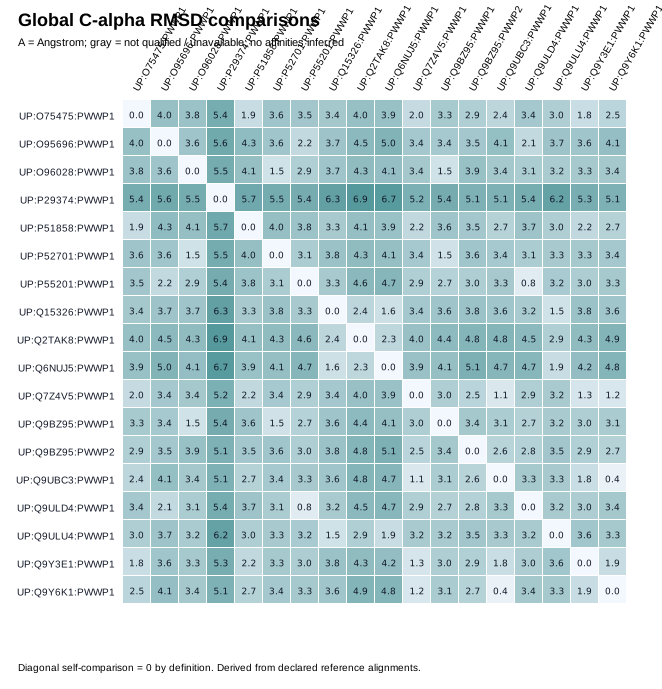
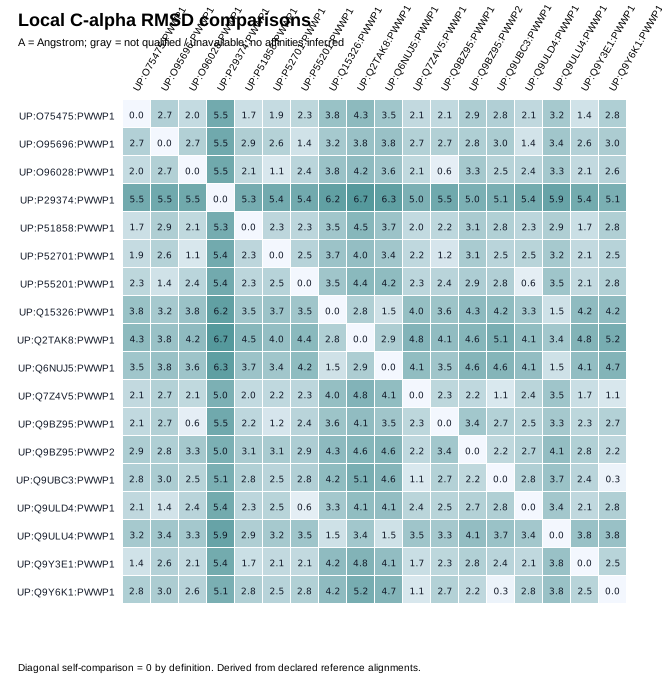
Least-squares Cα RMSD across qualified evolutionary correspondence. Grey indicates unsupported comparisons.
NSD2-reference alignment region
A transferred alignment patch defined by NSD2 deposited ligand contacts; not proof that other domains contain the same functional site.
All source-qualified ligand instances
Inspect deposited environments
2 matching deposited instances; results are separated by experimental chain and exact ligand instance. Select a site to inspect original coordinates, mapped residues, local chemistry and geometric limitations.
| Deposition | Mapped PWWP domain | Deposited ligand | Local 5 Å contacts | Core quality | Archetype | Detail |
|---|---|---|---|---|---|---|
| 4Z02 · A | UP:O95696:PWWP1 | 4K8 | 8 | 0 incomplete side chains | ARC-8f3997b20178 | Inspect evidence |
| 4Z02 · B | UP:O95696:PWWP1 | 4K8 | 7 | 0 incomplete side chains | Unqualified | Inspect evidence |
Family-wide research evidence
The frozen 39-instance PWWP evolutionary alignment contains 27 domains with at least one observed experimental core and six domains with source-classified deposited research-ligand sites. These totals are not counts of independent ligand-binding experiments. The comparative family gap inventory distinguishes absence of recorded experimental structural evidence from absent biochemical evidence.
Reproducibility and research questions
Original 230 historical mmCIF coordinate files are unchanged. The Phase 6D analysis independently measured 111 ligand-bearing structures and examined 18 representative domains across the family. Native residue identity, experimentally mapped core completeness, source-deposited ligand geometry and literature biochemical evidence remain separately sourced.